Articles tagged with: Law & Technology
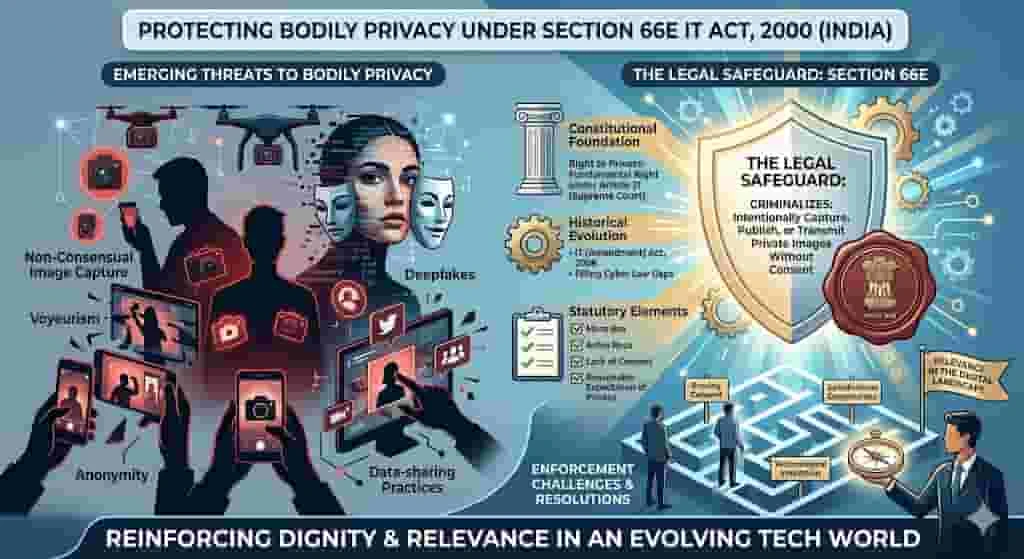
Section 66E of the IT Act 2000: Violation of Privacy
This paper examines Section 66E of the Information Technology Act, 2000 as a safeguard against violations of bodily privacy in the digital age. It outlines the provision’s evolution, its constitutional grounding in the right to privacy under Article 21, and analyzes key elements like consent, mens rea, and reasonable expectation of privacy. The paper also highlights enforcement challenges such as anonymity, jurisdictional issues, and deepfakes and concludes that Section 66E remains crucial for protecting dignity and privacy amid evolving technologies.
26
1
1.11

Fragmentation v. Harmonization in AI Governance
This paper analyzes the fragmentation of global AI governance and its impact on regulatory harmonization. It compares differing approaches across major jurisdictions like the EU, US, China, and India, highlighting how competing priorities create inconsistent standards and compliance challenges, including regulatory arbitrage and “shadow AI.” It also examines barriers to human-centered AI governance, such as voluntary standards, gaps between ethical principles and technical implementation, and rapid technological change. While reviewing multilateral efforts like OECD and UN frameworks, the paper concludes that full harmonization is unlikely and instead proposes a federated model that enables interoperability through shared standards while preserving regulatory diversity.
11
2
1.08

SEP AND FRAND OBLIGATIONS IN INDIA: AN ANALYSIS OF ABUSE OF DOMINANCE AND CCI’S JURISDICTION UNDER COMPETITION LAW
The greater involvement of technology in the current economies has necessitated standardisation in various industries, including telecommunications, electronics, and digital networks. The fundamental element in this system is the existence of Standard Essential Patents (SEPs). SEPs cover patents whose technologies must be implemented in order to comply with standards. In order to align the rights associated with the protection offered by patents with the need to make technology available, SEP holders are obliged to license the technologies under fair, reasonable, and non-discriminatory terms (FRAND). Nevertheless, the enforcement of FRAND undertakings has posed several legal and economic issues. The present dissertation seeks to explore the emerging case laws regarding the jurisprudence relating to SEPs and FRAND obligations in India, with special reference to the intersection between patent law and competition law.
28
2
1.14